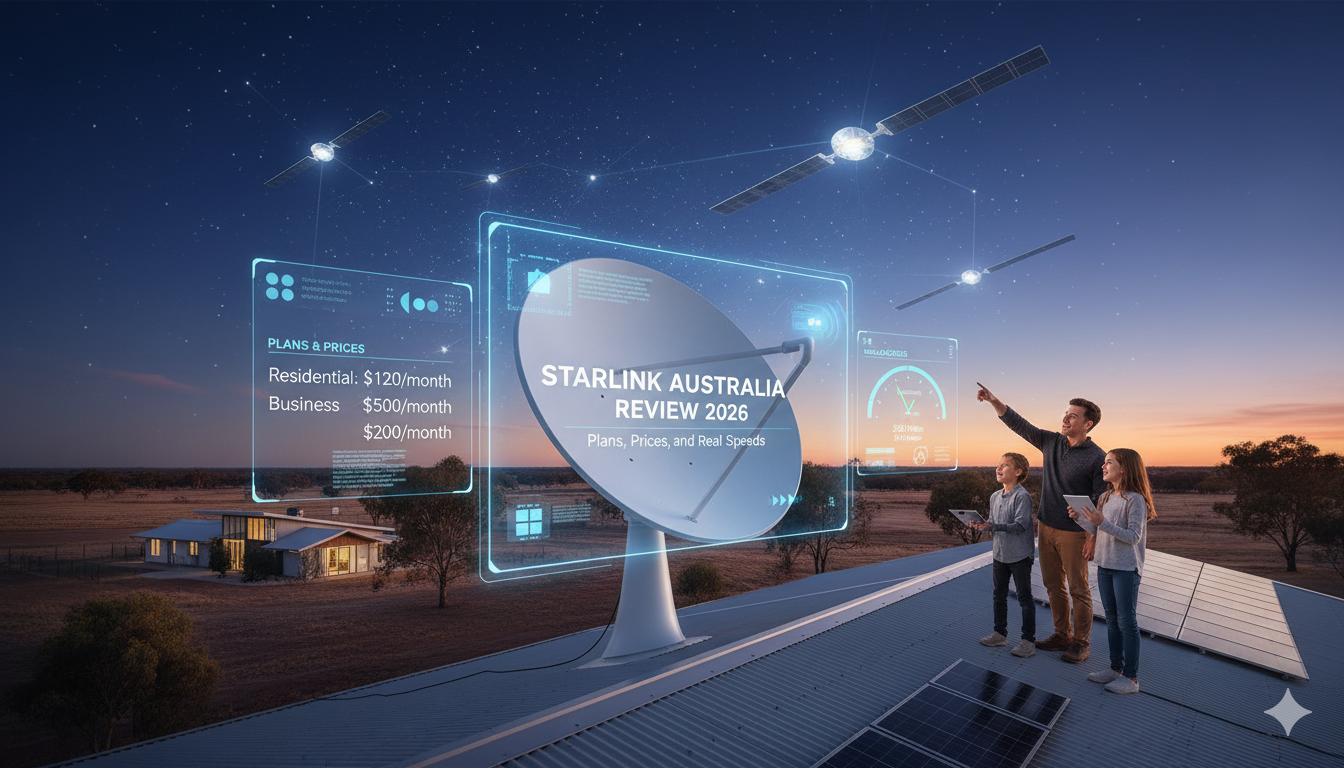
Have you ever been stuck in the middle of a beautiful Aussie sunset, only to have your Netflix show buffer right at the climax? If you live in regional or rural parts of our sunburnt country, you know the struggle of slow internet all too well. For years, we relied on older satellite tech that felt like it was stuck in the dial-up era. But then, Starlink Australia arrived and changed the game for everyone from Tassie to the Top End.
Think of Starlink Australia as a giant web of small satellites floating just above our heads. Unlike the old satellites that sat way out in space, these ones are much closer. This means your data doesn’t have to travel as far, making your internet feel snappy and fast. Whether you are running a farm, living in a van, or just tired of your local NBN connection, this service promises to bring the world to your doorstep without the lag.
What Exactly is Starlink and How Does It Work?
SpaceX, the company led by Elon Musk, created Starlink Australia to fix the world’s “dead zones.” They launched thousands of tiny satellites into Low Earth Orbit (LEO). Because these satellites are only about 550km away from us—instead of 35,000km like traditional ones—the signal is much stronger. When you set up your “Dishy,” it talks to these satellites as they zoom past, giving you a constant stream of data.
In the past, satellite internet was a last resort. It was slow, expensive, and had tiny data caps. Starlink Australia flipped that script by offering unlimited data and speeds that can actually compete with city fiber. It is designed to be “plug and play,” meaning you don’t need a professional technician to drill holes in your walls if you don’t want to. You just need a clear view of the Southern Cross and the rest of the sky!
Comparing the Best Starlink Australia Plans
Choosing a plan shouldn’t feel like a math test. Currently, Starlink Australia offers a few straightforward options depending on where you live and how you move. Most families will jump on the “Residential” plan. This is perfect for a fixed home. If you love to hit the road in a caravan, the “Roam” plan lets you take your internet with you across the country.
For those running big businesses or living in very crowded areas, there are “Priority” plans. These give you a “fast lane” on the network during busy times. It’s also worth noting that Telstra has teamed up with Starlink Australia to offer their own specialized plans. While Telstra’s version might have speed caps, it often comes with the benefit of local Aussie support and bundled home phone services.
Breaking Down the Hardware and Setup Costs
Let’s talk about the “elephant in the room”—the upfront cost. To get started with Starlink Australia, you need to buy the hardware kit. This usually includes the satellite dish, a Wi-Fi router, and all the cables. In 2026, the standard kit price sits around $599, though you can sometimes find refurbished units for about $299 if you want to save some dollarydoos.
If you aren’t ready to commit to buying the gear, Starlink Australia now offers a rental option for about $19 a month. This is a fantastic way to test the service without dropping hundreds of dollars at once. Don’t forget about the shipping fee, which is usually around $30. It might seem like a lot compared to a “free” NBN modem, but remember, you are buying a piece of space-age technology that works anywhere.
Real-World Speeds: What Can You Actually Expect?
One of the biggest questions people ask is: “How fast is it really?” Most Starlink Australia users see download speeds between 50 Mbps and 200 Mbps. To put that in simple terms, you can easily stream 4K movies on three different TVs while someone else is playing a video game. It’s a massive jump from the 25 Mbps limit many rural Aussies are used to.
Latency (or “ping”) is another win for Starlink Australia. While old satellites had a delay of 600ms (which made video calls impossible), Starlink usually sits between 25ms and 60ms. This is low enough for smooth Zoom meetings and even online gaming. Just keep in mind that heavy rain or thick clouds can occasionally slow things down for a few minutes, but it usually bounces back quickly.
Detailed Starlink Australia Comparison Table
| Feature | Residential Plan | Roam (Mobile) Plan | Priority (Business) |
| Monthly Cost | ~$139 AUD | ~$174 – $195 AUD | ~$230+ AUD |
| Hardware Cost | $599 (or $19/mo rent) | $599 | $3,740 (High Perf) |
| Typical Speeds | 50 – 200 Mbps | 50 – 100 Mbps | 40 – 220+ Mbps |
| Data Limit | Unlimited | Unlimited | Capped (then unlimited) |
| Best For | Fixed Homes | Caravans & Boats | Large Offices/Farms |
| Portability | No (Locked to address) | Yes (Work anywhere) | Optional |
Is Starlink Better Than NBN Fixed Wireless?
This is the great Aussie debate! NBN Fixed Wireless and Sky Muster are the traditional choices. NBN is often cheaper per month, and the equipment is usually provided for free. However, Starlink Australia often leaves NBN in the dust when it comes to raw speed and reliability. If you only use the internet for emails, NBN might be fine. But if you work from home, Starlink is often worth the extra cost.
Another thing to consider is the “busy hour” slowdown. Because Starlink Australia has so many satellites, it handles “peak times” (like 7 PM when everyone is watching TV) much better than NBN satellite services. While NBN is working hard to upgrade its towers, Starlink is already delivering next-gen performance today. It really comes down to whether you prefer a lower bill or a faster connection.
Setting Up Your Starlink Kit Like a Pro
You don’t need to be a rocket scientist to install Starlink Australia. The kit comes with a base that works great on flat ground or a shed roof. The most important step is using the Starlink App on your phone. The app uses your camera to scan the sky for “obstructions” like tall gum trees or your neighbor’s chimney. If the dish can’t see the satellites, your internet will drop out.
Once you find a clear spot, you just plug it in and wait about five minutes. The dish will move itself to find the best signal. In 2026, the newer Gen 3 dishes don’t even move; they are flat and use special tech to “look” around the sky electronically. This makes Starlink Australia even tougher against wind and weather. Just make sure your cables are tucked away safely so the local cockatoos don’t have a chew!
Starlink for Caravans and the Great Aussie Road Trip
The “Roam” version of Starlink Australia has become a cult favorite for “grey nomads” and young families traveling the coast. Imagine being parked at a remote beach in WA and still being able to FaceTime your grandkids or upload a YouTube vlog. With the Starlink Mini, which is small enough to fit in a backpack, staying connected while camping has never been easier.
The best part about the Starlink Australia Roam plan is that you can “pause” it. If you only travel for three months of the year, you only pay for those three months. When you get back home, you just turn it off through the app. It gives you the freedom to explore the outback without ever being truly “off the grid”—unless, of course, you want to be!
Addressing Common Concerns: Weather and Support
A common worry is whether Starlink Australia works when the weather turns nasty. While a massive tropical storm might cause a brief flicker, the system is surprisingly hardy. The dishes have a “snow melt” mode (though we don’t need that much in Oz!) and are built to handle the scorching heat of the outback. If it’s just a regular rainy day, you probably won’t even notice a difference.
The one area where Starlink Australia can be tricky is customer service. They don’t have a phone number you can call for a chat. Everything is done through “support tickets” in the app. This can be frustrating if your internet is down and you can’t get online to ask for help! However, most issues are solved by simply checking your cables or restarting the router.
The Future of Connectivity in Rural Australia
Looking ahead, Starlink Australia is only going to get better. SpaceX is constantly launching more satellites, which means more capacity and even higher speeds. There are even whispers of “Direct-to-Cell” technology, which would allow your normal mobile phone to connect to satellites for emergency texts when you have no bars.
This technology is bridging the digital divide. It means a kid on a cattle station in the Northern Territory has the same educational opportunities as a student in Sydney. Starlink Australia isn’t just about watching movies; it’s about making sure no Australian is left behind in our digital world. It’s an exciting time to be online, no matter where you choose to call home.
Final Verdict: Should You Make the Switch?
So, is Starlink Australia the right choice for you? If you live in a big city with great 5G or fiber, probably not—it’s likely more expensive than what you already have. But if you are struggling with a patchy NBN connection or live where the “cables don’t go,” it is a total game-changer. The freedom, speed, and ease of use make it the gold standard for regional internet.
Investing in Starlink Australia is an investment in your lifestyle. It removes the frustration of the “spinning wheel of death” and lets you enjoy the best of both worlds: the peace of the country and the speed of the city. If you’re ready for a change, grab a kit, point it at the sky, and join the thousands of Aussies already living in the future.
Frequently Asked Questions
1. Does Starlink Australia have a data cap?
No! The Standard Residential and Roam plans currently offer unlimited data. You can stream, download, and browse as much as you like without worrying about extra charges or being slowed down at the end of the month.
2. Can I install Starlink Australia myself?
Absolutely. The kit is designed for DIY setup. As long as you can find a clear patch of sky and plug in a couple of cables, you’ll be online in minutes. The app guides you through every single step.
3. What happens if I move houses?
If you have the Residential plan, you just need to update your address in the Starlink app. If there is space in your new area, the service moves with you. If you have the Roam plan, you don’t have to do anything—it works wherever you go!
4. Is Starlink Australia good for gaming?
Yes! Because the satellites are in Low Earth Orbit, the latency is low enough for games like Fortnite, Call of Duty, or Roblox. It’s much better for gaming than older satellite providers.
5. Do I need a special router for Starlink?
The kit comes with a very capable Wi-Fi router. However, if you have a big house, you might want to buy “Mesh Nodes” from the Starlink shop to make sure the signal reaches every room, or use an adapter to plug in your own existing router.